
Why do millions of people open a language app every single day, even on days they don't feel like it? A big part of the answer is gamification.
In the third quarter of 2026, Duolingo averaged 64.9 million daily active users, up 29% from a year earlier. Its daily users also made up a bigger share of its monthly users, rising from 37.3% to 42.4%. Streaks, points, and friendly competition are a big reason people come back.
This guide explains the key features of gamification in mobile apps, how each one works, real examples, what the data says, and how to use them without annoying or manipulating your users.
Gamification in mobile apps means adding game-like features, such as points, levels, progress bars, badges, streaks, challenges, leaderboards, and rewards, to a non-game app to make it more motivating and habit-forming. The best apps pick a few features that fit their users and goals, test them, and keep them honest.
What Is Gamification in Mobile Apps?
Gamification is the use of game design ideas in something that isn't a game. A fitness app that rewards daily goals, a banking app that celebrates savings milestones, and a learning app that tracks streaks all use it.
Here's how it differs from similar ideas.
What it is | Example | |
|---|---|---|
Gamification | Game features added to a regular app | A learning app with XP and streaks |
A game | A product that is played from start to finish | A puzzle or action game |
A loyalty program | Rewards for spending or repeat purchases | Points for every coffee bought |
Serious game | A full game built to teach or train | A flight training simulator |
Gamification works best when it supports a real goal for the user, such as learning, saving money, or getting fit. Without that, it feels like decoration.
Why Gamification Works
Gamification works because it connects with basic human motivations. You don't need to be a psychologist to use it, but a few ideas help.
Motivation | What it means | Features that serve it |
|---|---|---|
Competence | Feeling good at something and making progress | Levels, progress bars, badges |
Autonomy | Having choice and control | Customization, choosing challenges |
Connection | Feeling part of a group | Friends, teams, leaderboards among friends |
Goal gradient | Trying harder as the finish line gets closer | Progress bars, milestones |
Loss aversion | Not wanting to lose what you've built | Streaks, saved progress |
Curiosity and surprise | Enjoying unexpected rewards | Mystery rewards, limited-time events |
One caution: the same ideas can be used to manipulate people. We cover how to avoid that later.
12 Key Features of Gamification in Mobile Apps
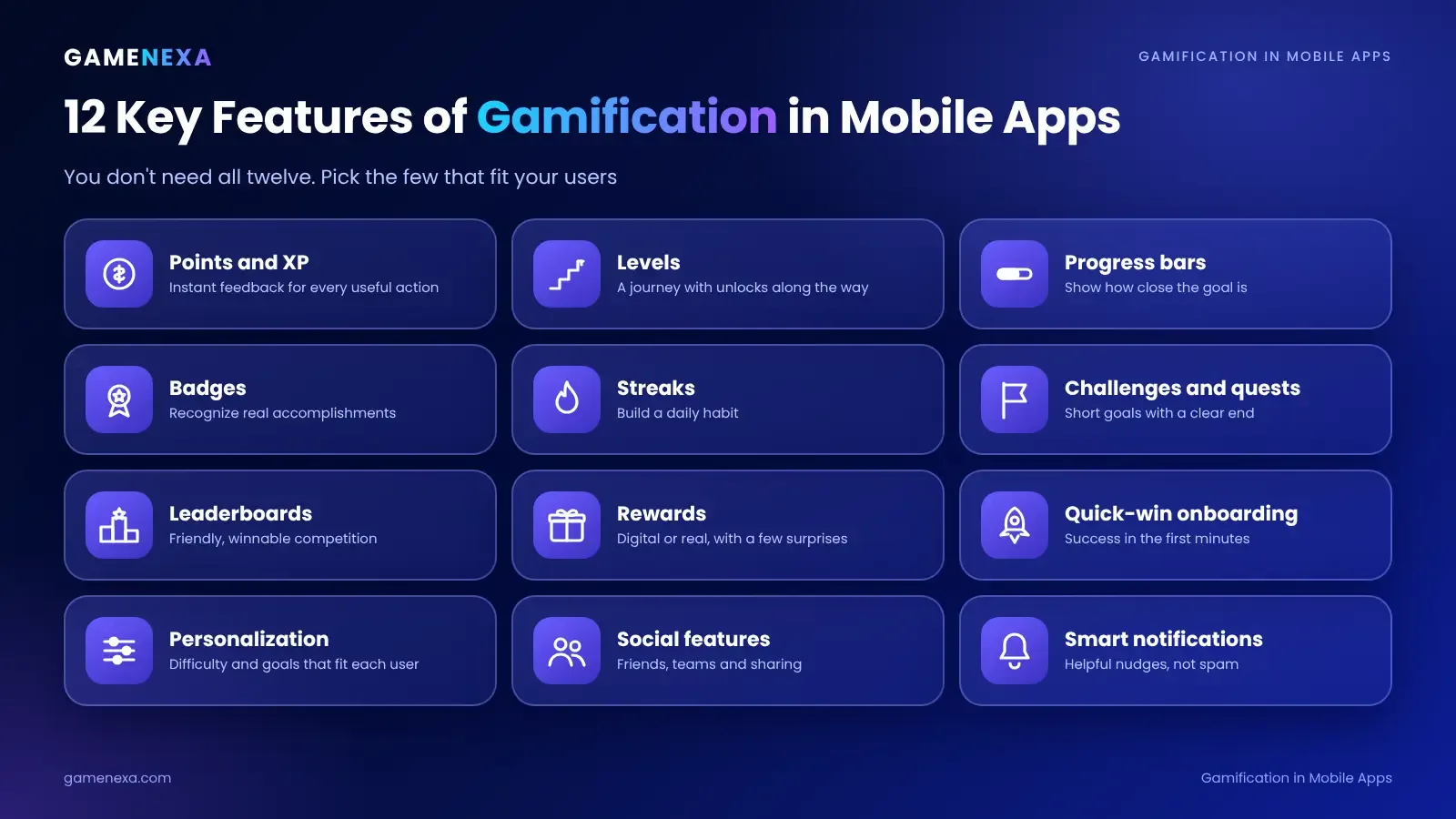
Here are the features you'll see in most successful gamified apps. You don't need all twelve. Pick the few that fit your users.
1. Points and Experience (XP)
Points give instant feedback. Every useful action earns something, whether it's finishing a lesson, logging a workout or making a payment.
Why it works: It makes progress visible and countable.
Example: Duolingo awards XP for each lesson completed.
Design tip: Reward actions that matter to the user's real goal, not just taps or time spent.
Watch out for: Points inflation. If rewards are too easy, they stop feeling meaningful.
2. Levels and Progression
Levels turn points into a journey. Users unlock new content, features, or titles as they go.
Why it works: It creates a sense of growth and a reason to keep going.
Example: Many fitness and learning apps unlock tougher plans or lessons as you advance.
Design tip: Make early levels quick and later levels slower, so new users feel progress right away.
Watch out for: Walls. If a level feels impossible, users quit.
3. Progress Bars and Milestones
A progress bar shows how close someone is to a goal. It uses the goal gradient effect, where people try harder as the finish gets closer.
Why it works: It makes the next step obvious, and the goal feel reachable.
Example: A profile completion bar, or a monthly savings target in a finance app.
Design tip: Start the bar partly filled. People are more likely to finish something that already looks started.
Watch out for: Long bars with no checkpoints. Break big goals into small milestones.
4. Badges and Achievements
Badges recognize specific accomplishments, like finishing a first workout or hitting a 30-day goal.
Why it works: They give users something to collect and show off.
Example: Fitness apps celebrate first runs, personal bests, and distance milestones.
Design tip: Tie badges to meaningful actions and skill, not to simple logins.
Watch out for: Badge spam. Too many cheap badges make all of them feel worthless.
5. Streaks
A streak counts consecutive days (or weeks) of activity. It's one of the strongest habit tools in mobile apps.
Why it works: Users don't want to lose something they've built.
Example: Duolingo's streak is central to its product. In 2026, it ran a Streak Revival campaign that let eligible learners restore a lost streak after finishing three lessons. About 15.4 million learners revived streaks, including nearly 8 million who had no active streak when the campaign began.
Design tip: Offer ways to protect a streak, such as a freeze or a rest day, so one missed day doesn't cause rage-quits.
Watch out for: Anxiety. A streak that punishes harshly can push users to quit for good, so test it carefully.
6. Challenges and Quests
Challenges give users short-term goals, such as a weekly step goal or a daily mission.
Why it works: They add variety and a reason to return today, not someday.
Example: Daily quests in learning apps, and monthly distance challenges in running apps.
Design tip: Make challenges winnable, with a clear reward and a clear end.
Watch out for: Fatigue. Too many daily tasks start to feel like chores.
7. Leaderboards
Leaderboards rank users by points, distance, or another measure.
Why it works: They add competition and social comparison.
Example: Running apps compare friends' distances, and Duolingo groups learners into weekly leagues.
Design tip: Use friend, local, or similar-skill leaderboards. A global top 100 is unreachable for most people and can demotivate them.
Watch out for: Cheating. Leaderboards attract bots and fake accounts, so you need fraud checks.
8. Rewards and Virtual Goods
Rewards can be digital, such as coins, avatars, themes, and bonus content, or real, such as discounts and free items.
Why it works: They give a tangible sense of reward and let users personalize their experience.
Example: Coffee chains award stars toward free drinks, and many apps let users collect avatar items.
Design tip: Mix predictable rewards with a few surprises. Occasional, unexpected rewards keep things interesting.
Watch out for: Leaning only on outside rewards. Pair them with real value, so users keep coming back because the app helps them, not just for prizes.
9. Onboarding With a Quick Win
The first minutes decide whether someone stays. Gamified onboarding gives the user a fast success.
Why it works: An early win builds confidence and trust.
Example: Letting new users try a short lesson, workout, or task before asking them to sign up.
Design tip: Reward the first action immediately, and show what comes next.
Watch out for: Long tutorials. Teach by doing, not by reading.
10. Personalization and Adaptive Difficulty
Personalization adjusts goals, content, and challenge to each user.
Why it works: It keeps tasks in the sweet spot between too easy and too hard.
Example: A learning app that adjusts lesson difficulty, or a fitness app that adapts goals to your recent activity.
Design tip: Let users choose their goals and pace. Choice builds ownership.
Watch out for: Creepy targeting. Be clear about what data you use.
11. Social and Community Features
Humans like doing things together. Social features add support, rivalry, and sharing.
Why it works: Friends keep each other accountable and make habits more fun.
Example: Friend challenges, team goals, shared achievements, and kudos on activities.
Design tip: Make social features optional and positive. Not everyone wants to compete.
Watch out for: Pressure and privacy. Give users control over what they share.
12. Smart Notifications and Nudges
Notifications remind users to come back, celebrate progress, and warn about streaks about to end.
Why it works: They bring users back at the right moment.
Example: A friendly reminder tied to a goal, or a message when a friend passes your score.
Design tip: Tie notifications to real goals and progress, and let users control the timing and frequency.
Watch out for: Spam. Too many messages lead to muted notifications and uninstalls.
What the Data Says About Gamification in Mobile Apps
Duolingo: the best-known example
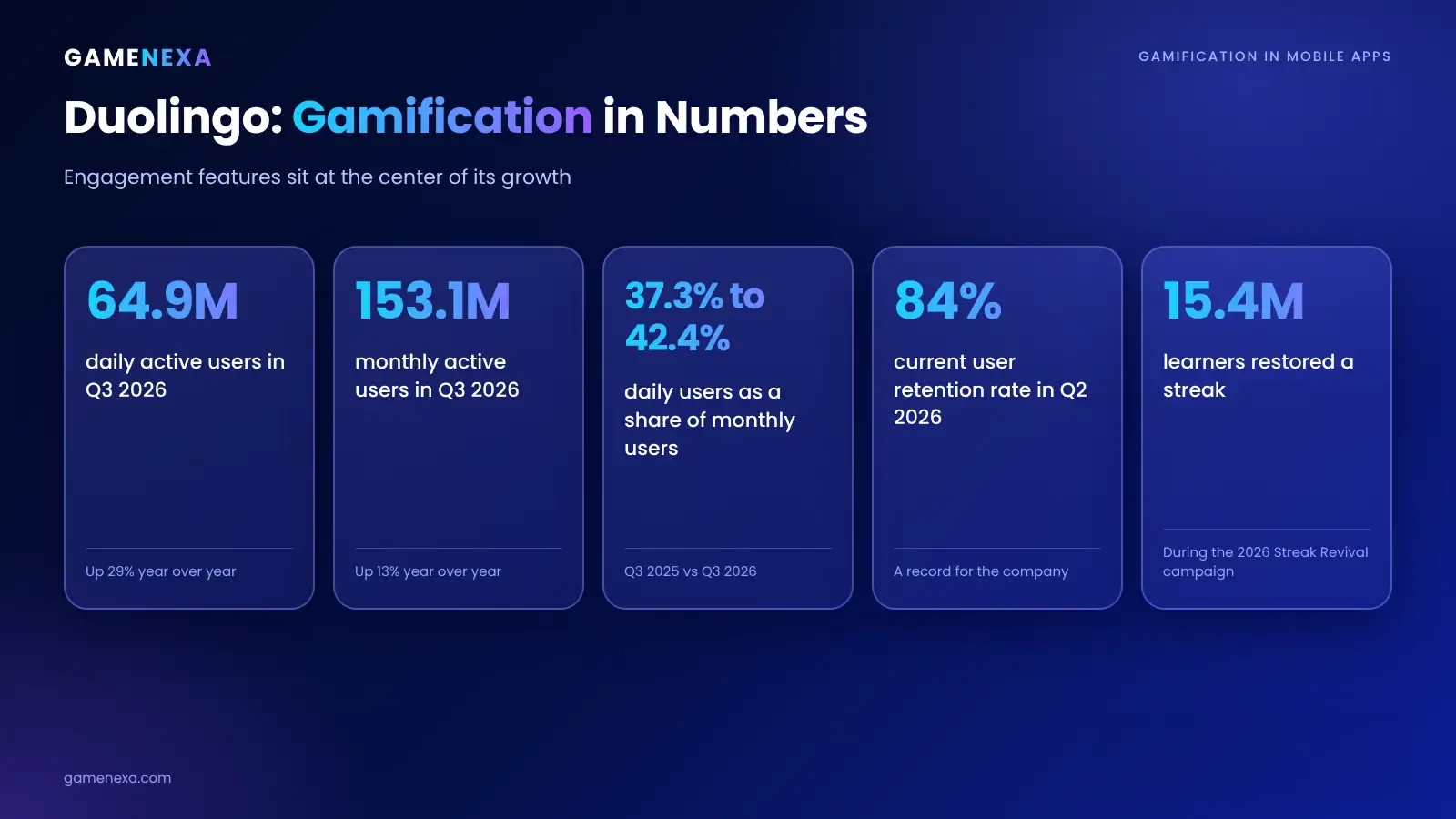
Duolingo is the textbook case of gamification in mobile apps. Its recent numbers show how engagement features can support growth.
Metric | Result |
|---|---|
Q3 2026 daily active users | 64.9 million, up 29% year over year |
Q3 2026 monthly active users | 153.1 million, up 13% |
Daily users as a share of monthly users | Up from 37.3% to 42.4% |
Q2 2026 current user retention rate | A record 84% |
Streak Revival campaign | About 15.4 million learners restored a streak |
Duolingo's management has said most of its user growth comes from better retention, and the company runs hundreds of experiments on things like notifications and streaks. Gamification alone didn't produce these numbers. Product quality, AI features, marketing, and partnerships also matter. But the numbers show how central engagement features are.
Which features move retention most?
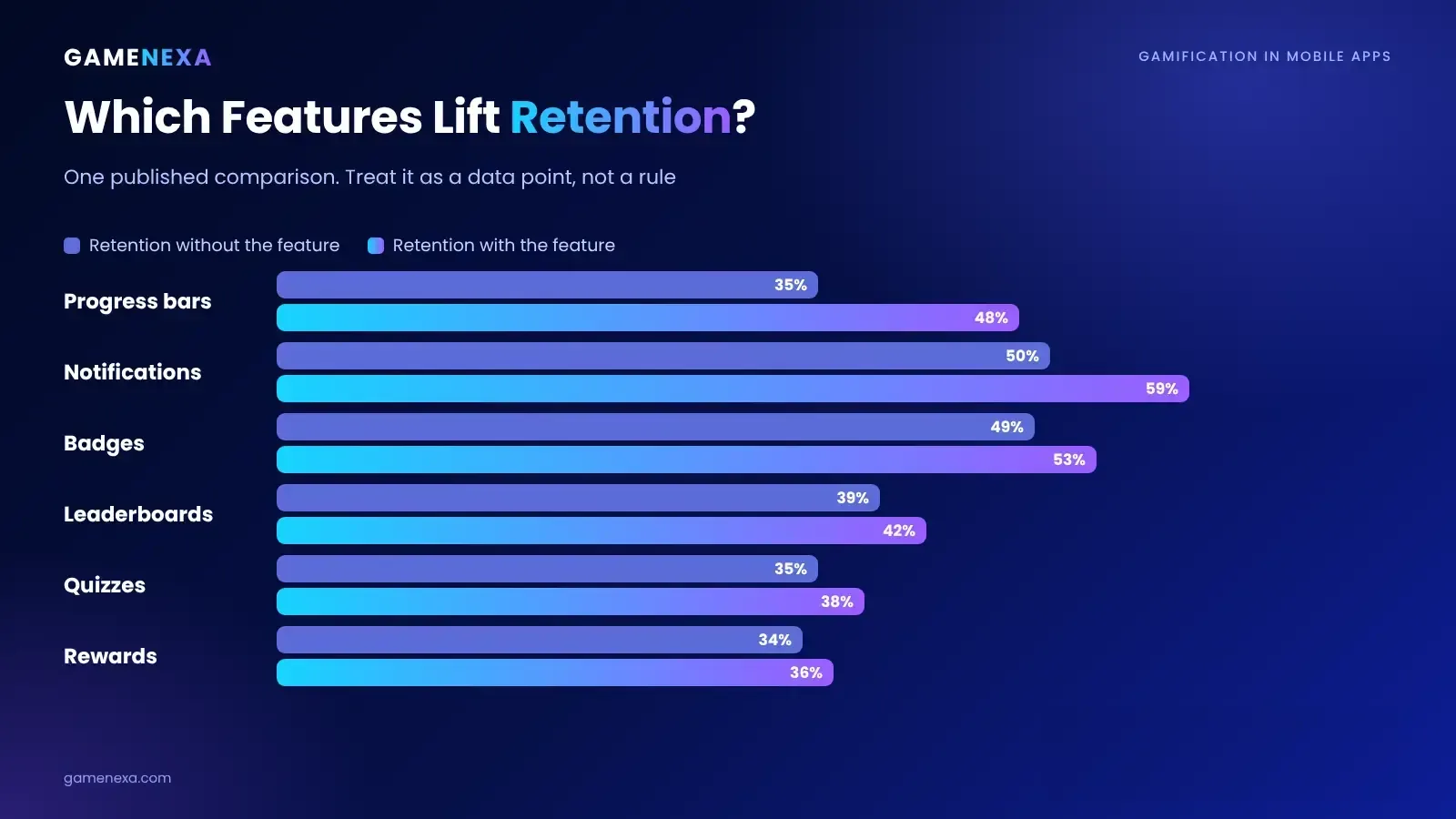
One published comparison from NP Digital looked at retention with and without specific features across its apps and seven clients.
Feature | Retention without | Retention with |
|---|---|---|
Progress bars | 35% | 48% |
Notifications | 50% | 59% |
Badges | 49% | 53% |
Leaderboards | 39% | 42% |
Quizzes | 35% | 38% |
Rewards | 34% | 36% |
Treat this as one data point, not a rule. It's a small, company-reported sample. It does suggest something useful: visible progress and well-timed reminders may do more than extra prizes.
A warning from experts
Gamification statistics vary a lot. Designer Yu-kai Chou, who created the Octalysis framework, points out that the same mechanic can multiply retention in one product and hurt it in another. The lesson is simple: test everything with your own users, and ask when a mechanic might backfire.
Examples of Gamification in Mobile Apps
App type | Example | Key features used |
|---|---|---|
Language learning | Duolingo | XP, streaks, leagues, quests, friendly mascot |
Fitness | Apple Fitness rings, Strava | Daily rings to close, segments, challenges, kudos |
Coffee and retail | Starbucks Rewards | Stars, tiers, free rewards, offers |
Habit building | Habitica | Turns habits into a role-playing game with levels and rewards |
Finance and savings | Many budgeting apps | Savings goals, milestones, streaks for saving |
Health and wellness | Meditation and sleep apps | Streaks, progress tracking, gentle reminders |
Notice the pattern. Each one ties its game features to a real outcome the user cares about.
Gamification in iGaming and Casino-Style Apps
Gamification is common in iGaming apps too, with loyalty tiers, missions, daily rewards, and leaderboards. But the rules are different here.
Regulators care about player protection. In many markets, features that encourage excessive play can cause problems.
Build in safeguards. Offer deposit limits, session reminders, time-outs, and self-exclusion alongside any reward system.
Be transparent. Make bonus terms, odds, and rules easy to understand.
Never touch game fairness. Gamification layers must not change certified game results.
Check local rules. Promotions and rewards are regulated differently in each market.
See our guides on how to build an iGaming platform from scratch and artificial intelligence in game development for more on responsible design.
How to Add Gamification to Your Mobile App: Step by Step
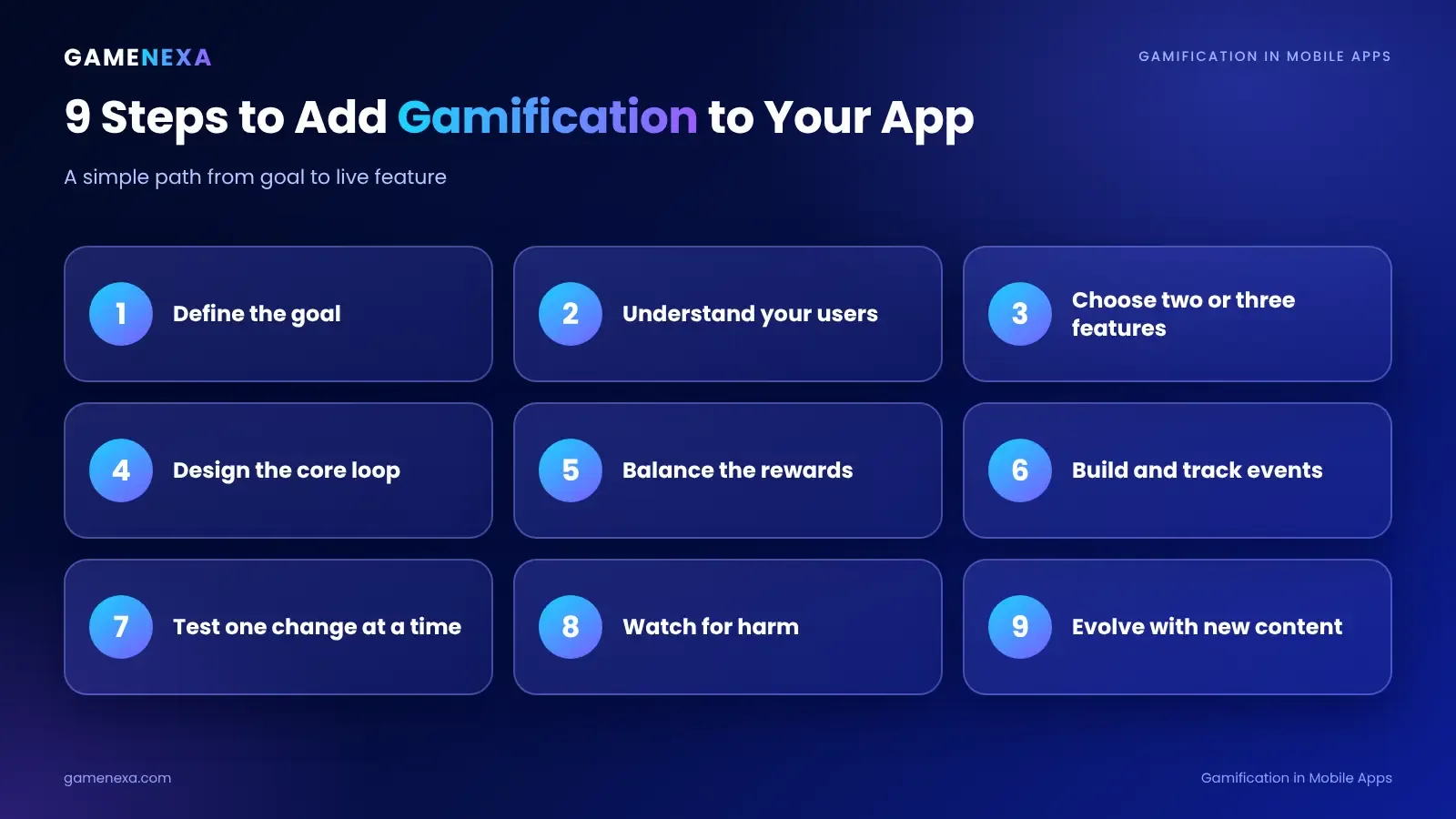
Define the goal. What should users do more of? Complete lessons, log workouts, save money, invite friends?
Understand your users. What motivates them? Competition, progress, collecting, helping others?
Choose two or three features. Start small. A streak, a progress bar, and a few badges can be enough.
Design the core loop. Action, then feedback, then reward, then a reason to return.
Balance the rewards. Make early wins fast, mid-game progress steady, and long-term goals meaningful.
Build and track events. Log key actions so you can see what's working.
Test. Run A/B tests on one change at a time, such as a streak freeze or a new challenge.
Watch for harm. Check for anxiety, cheating, and unhealthy patterns, and fix them.
Evolve. Add seasonal events, new challenges, and fresh rewards so the app stays interesting.
Metrics to Track
Metric | What it tells you |
|---|---|
Day 1, Day 7, and Day 30 retention | Whether users come back |
Daily and monthly active users (DAU/MAU) | How sticky the app is |
Session length and frequency | How engaged users are |
Streak length | How strong the habit is |
Challenge completion rate | Whether goals are the right difficulty |
Feature adoption | Which features users actually use |
Conversion to paid | Whether engagement leads to revenue |
Uninstalls and notification opt-outs | Signs you're overdoing it |
Track results against a control group when you can, so you know the feature caused the change.
Common Gamification Mistakes
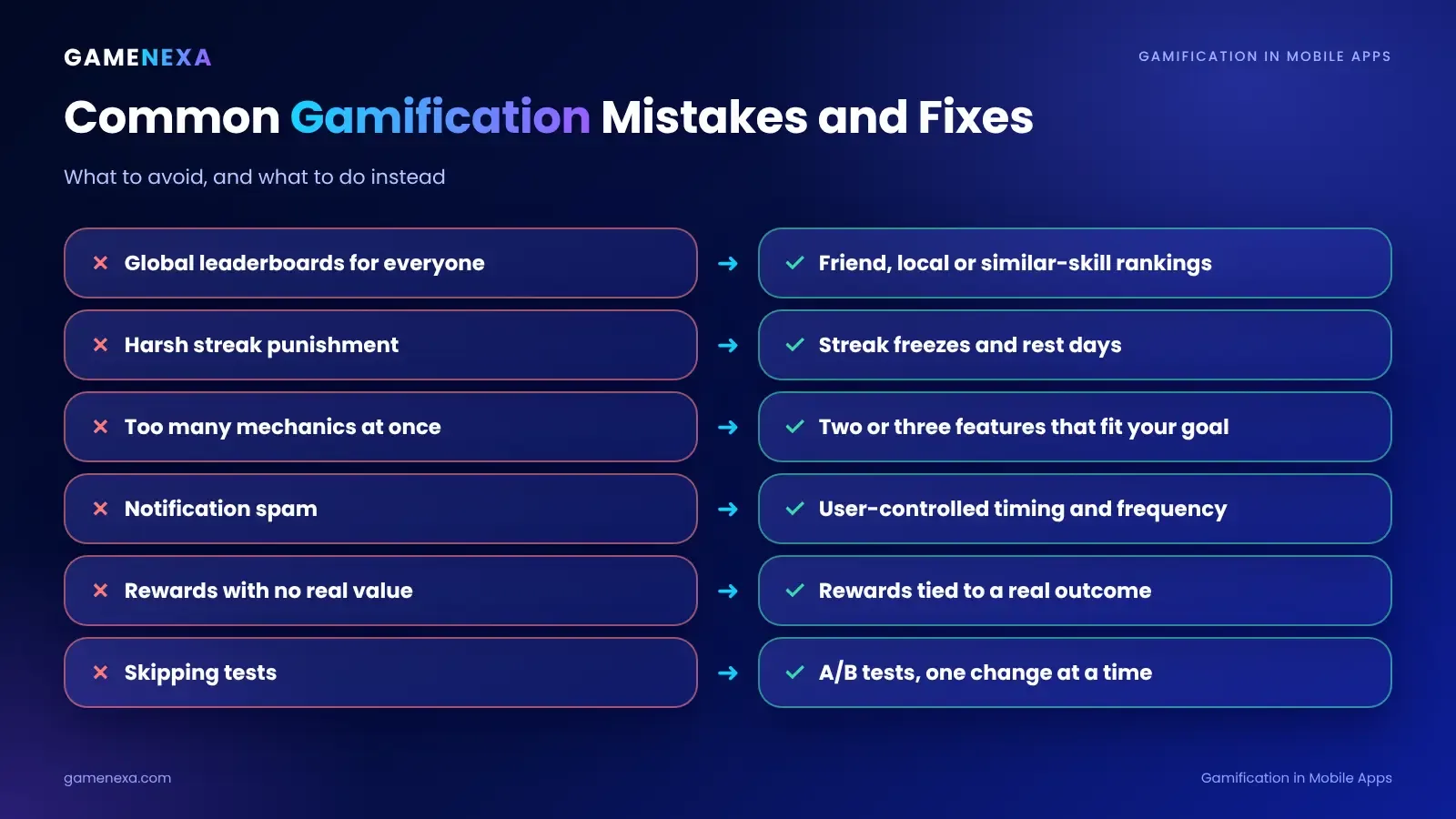
Adding points, badges, and leaderboards to everything. These are the most common features and also the most often misused. Use them with purpose.
Too many mechanics at once. Feature overload confuses users and dilutes the value of each one.
Global leaderboards for everyone. Most users can't win, so they stop trying. Use friend or local rankings.
Harsh streak punishment. Losing a long streak can make users quit for good.
Rewards with no real value. If the app doesn't help users, prizes won't keep them.
Ignoring accessibility. Don't rely on color alone, and avoid rapid flashing effects.
Skipping tests. What works in one app can fail in another.
Spamming notifications. More reminders aren't more engagement.
Ethics and Player Wellbeing
Gamification should help users, not trick them. Keep these principles in mind.
Be honest. Don't use fake urgency or hidden rules.
Give control. Let users mute notifications, pause streaks, and opt out of competition.
Respect time. Don't design to keep people hooked at the cost of sleep or health.
Protect younger users. Follow children's privacy laws and age-appropriate design rules in your markets.
Protect data. Collect only what you need and explain how you use it.
What Does It Cost to Add Gamification?
It depends on how much you add. As a rough guide, a basic layer of points, streaks, and badges is often a matter of weeks for an existing app, while a full system with quests, leagues, live events, and fraud protection takes months. Costs rise with the number of features, the backend work to track and reward actions, and the testing needed. A clear scope and a phased rollout keep costs predictable.
To see how time and budget work in practice, read our guides on how long it takes to make a mobile game and the game development process.
Why Build Gamified Apps With Gamenexa
Gamenexa is a game development and iGaming software company with 11 years of experience, 60+ clients and 200+ projects delivered. We bring game design experience to apps of all kinds, so your features feel fun and fair, not forced.
What you get:
Features matched to your users. We pick mechanics that fit your goals and audience.
A clear plan and estimate. Scope, milestones, and costs agreed up front.
Experience across game types. Casual, multiplayer, skill-based, and iGaming products.
Testing built in. Analytics and experiments so you know what works.
Support after launch. Updates, new events, and improvements.
Ready to add gamification to your app? Explore our game development services or contact our team for an estimate.
FAQ: Gamification in Mobile Apps
What is gamification in mobile apps?
It's the use of game-like features, such as points, levels, badges, streaks, challenges, and leaderboards, in a non-game app to make it more engaging and encourage useful habits.
What are the key features of gamification in mobile apps?
The key features are points and XP, levels, progress bars, badges, streaks, challenges and quests, leaderboards, rewards, quick-win onboarding, personalization, social features and smart notifications.
Does gamification improve user retention?
It can, but results vary. Features like progress bars, streaks, and well-timed notifications often help, while poorly designed points and leaderboards may do little. Always test with your own users.
Which gamification feature is most effective?
There's no single winner. Visible progress and streaks are widely used because they build habits, but the best feature depends on your users and goals. One published comparison found progress bars and notifications had the largest retention lift.
What are examples of gamified mobile apps?
Duolingo for language learning, Apple Fitness and Strava for fitness, Starbucks Rewards for retail loyalty, and Habitica for habit building are well-known examples.
How do I add gamification to my app?
Start with a clear goal, choose two or three features that fit your users, design a simple core loop, track events, run A/B tests, and improve over time.
Can gamification backfire?
Yes. Too many features, harsh streak penalties, unreachable leaderboards, and manipulative design can frustrate users and hurt retention. Test and listen to feedback.
Is gamification suitable for every app?
Not always. It works best when it supports a real user goal, and the audience enjoys game-like features. For some serious or sensitive uses, a simpler design may be better.
How much does gamification development cost?
It depends on scope. Basic features like points, streaks, and badges can be added in weeks for an existing app, while full systems with quests, leagues, and fraud protection take months. Ask for an itemized estimate.
Final Thoughts
The key features of gamification in mobile apps are simple on paper: progress, rewards, goals, competition and community. The hard part is choosing the right few for your users and keeping them honest.
Start small, tie every feature to a real benefit, test relentlessly, and care about your users' well-being. Do that, and gamification becomes a reason people love your app, not a trick to keep them tapping.
Ready to build something people come back to? Get in touch with Gamenexa and let's plan it.